Hard floor care, marble polishing and crystallisation
Marble, granite, epoxy, vinyl, concrete and terrazzo. The floor is identified first, then the machine and the chemical. Do it the other way round and you pay for a new floor.
Hard floors do not fail overnight. They fail over months, from the wrong chemical and a machine that was never meant for that surface. By the time marble greys over or epoxy goes flat, you are no longer buying cleaning — you are buying restoration, at several times the price.
Survey first, machine second
We come out, identify the floor, run a test patch somewhere nobody looks, and only then write the method. The surface hardness, the depth of damage and how long the area can stay out of use decide what happens: scrub and extraction, diamond grinding, crystallisation, or a protective finish.
Marble and terrazzo
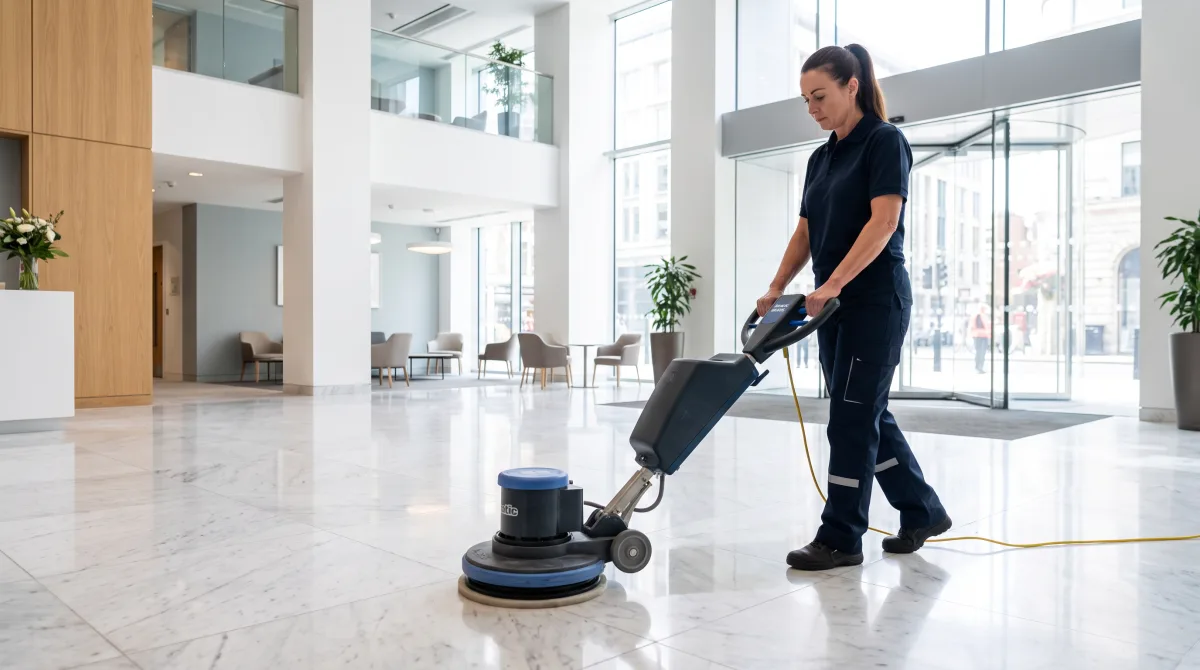
Crystallisation is not something poured from a bottle. It is a chemical-mechanical process that changes the top layer of the stone and produces a shine that does not wipe off. It works on marble and some terrazzo, not on granite and not on every slab. Where the stone has already been honed flat or carries deep scratching, grinding comes first and polishing after.
We will tell you plainly when crystallisation is not worth doing. Charging for a process that cannot deliver on your floor is not a business we are interested in being in.
Epoxy, vinyl and concrete
Industrial surfaces take a different regime. Epoxy is scrubbed with a neutral chemical; aggressive products strip the gloss and open the pores. Vinyl and safety flooring are deep-scrubbed and then sealed with a polymer finish that takes the wear instead of the floor itself. That finish is renewed once or twice a year depending on footfall.
Scheduling around your operation
Weekends or nights as a rule, because the floor has to dry and stay walked-off. Large areas are done in phases so the building keeps running.
You get the phasing and the hours in writing before we start. You also get a note of which areas are out of use on which day — the thing your facilities team has to circulate before anyone turns up to a closed corridor.
What you have afterwards
A clean floor, and a written maintenance regime until the next treatment. Most floors are not ruined during the treatment; they are ruined in the months between, by too much water, the wrong mop or a product someone bought because it smelled good.
Questions we get
How long is the floor out of use?
Scrubbing: a few hours. Crystallisation: walkable immediately, full shine after 24 hours. Polymer sealing: 12–24 hours with no traffic.
Does crystallisation damage the stone?
No, on the right substrate and at the right interval. Problems come from repeating it too often or applying it to stone that will not take it, which is exactly what the test patch is for.
How often should it be repeated?
It depends on footfall. A building entrance: two to four times a year. An office floor: annually. We give you the interval after the survey, not before.